|
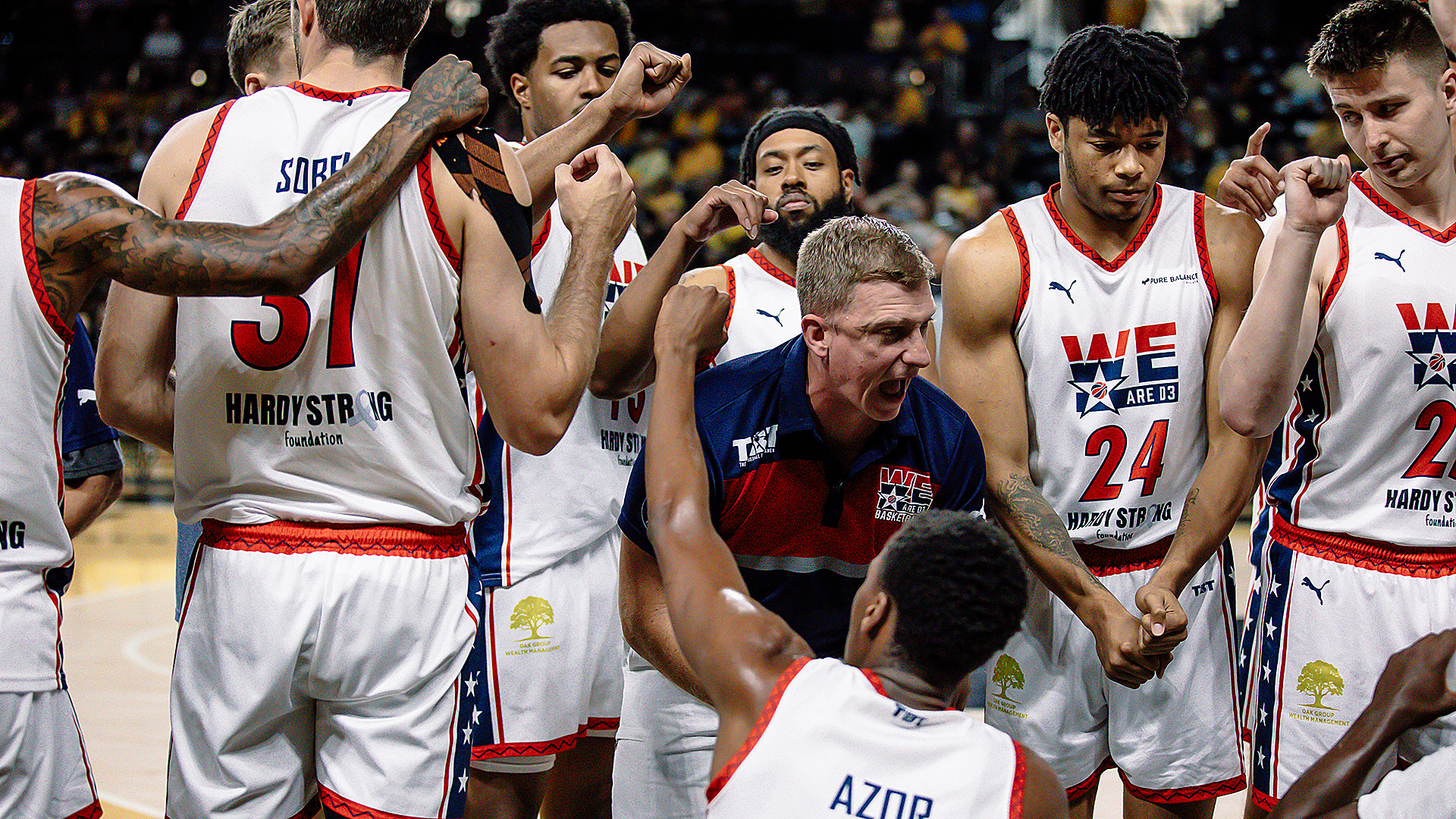
| With a loud and boisterous crowd in Wichita, Mike Rejniak needed every decibel to get his points across. TBT photo |
By Patrick Coleman
D3sports.com
WICHITA, Kansas — Even after taking a 66-54 loss to hometown favorite Aftershocks in front of a reported 5,500 fans, there remains little doubt that the Division III alumni team in The Basketball Tournament put itself on the map in the 2025 edition of the event.
We Are D3, sporting a No. 4 seed, matching its highest ever in the event, won four games in the six-round tournament, advancing to the Final Four. The team’s success gave Division III basketball a moment this summer, the likes of which it hasn’t seen perhaps since the Los Angeles Lakers drafted Augsburg’s Devean George in the first round of the NBA Draft in 1999.
On Thursday night, a couple of hours after the semifinal game with Aftershocks ended, players were going through the process of booking or rebooking flights after having spent more time together at TBT than almost anyone thought possible.
“I really feel like the guys broke down some barriers for us and the brand (of Division III),” coach Mike Rejniak said after Thursday’s game. “It really helped the message of what we’re all trying to show and contribute to.”
Some of the We Are D3 players are still looking for their next professional opportunity, others are changing leagues altogether, and some are going to be first-year pros, including Christian Parker (Mount Union), Hank Morgan (Hamilton), David Murray (Connecticut College) and Felix Kloman (Babson). Alex Sobel (Middlebury) is literally flying out on Monday to play in France, after a year where he got limited playing time in the top Israeli league.
But having a core group of guys who have played together for We Are D3 is one of the reasons why this team is successful. Here’s a little more about what’s going right for Rejniak’s team.
What’s going right
The core group: Four starters and a couple of key reserves returned once again this year for We are D3 and it helps immensely. Ty Nichols had a tournament to remember, averaging 21.4 points, while Marcus Azor and Dimitrius Underwood each returned and averaged double digits in scoring. Having these three core guys back multiple times helps with cohesiveness in an event where often teams are thrown together with little time to play together.
Unselfish play from the bench: There were 14 players who got playing time, but minutes at the end of the bench are sometimes pretty limited. And sometimes that can lead to griping and in-fighting among teammates, things which were visible at times among We Are D3’s opponents. But the folks at the end of the D3 rotation were supportive and positive, and generally contributed when they got opportunities. Jackson Meshanic scored 29.0 points per game this past season in Luxembourg, but played a total of five minutes in five games for D3, capped by a much-needed bucket off an inbounds play in the semifinals against Aftershocks. Thomas Quarry’s minutes were up and down, Murray had all 14 of his tournament points in one game: the round of 16 against Stars of Storrs. Morgan played just 31 minutes, 23 of them in one game. Eugene Campbell and Felix Kloman got even less playing time. But everyone seemed to understand their role.
The team is still young: A number of players in TBT are on the downswing of their careers – for example, Darius Adams, whose 44 points nearly brought Fail Harder all the way back in the round of 8, is 36 years old. But Nichols is 28, Underwood is 27, Azor is 25, and a bunch of guys are even younger. There are no Jeff Gibbses on this team, although We Are D3 would have loved to have had him on the roster more often over the years. If this core group stays together, D3 will be the better for it.
The cause: In addition to the cause of Hardy Strong, the team is committed to winning the right way, and winning as a true Division III teams. It was probably tempting to recruit players without any D-III background to try to get some wins, but We Are D3 remained committed to the D-III cause at its core.
What comes with success: A year with this much exposure and success brings more legitimacy to the program. It will make it easier to find sponsorship and compensate everyone involved for their time. It will also make it easier to recruit and get players to come to next spring’s combine in Boston. The annual combine is huge for recruiting people to the team and having more candidates can only make the final roster better. There’s nothing like four wins to solidify a team’s status in this event.
What We Are D3 needs
It’s not all perfect, obviously, or the team would still be playing, at a minimum, or would be bringing home the million dollar prize. Here are a couple of things this group needs.
Respect in seeding and a home floor: We Are D3’s seed has certainly improved over the years, but only slowly. Taking Mass Street to the buzzer in 2023 got D3 a four seed last year, and last year’s win plus taking another one-seed down to the wire got D3 … another four seed. Next season this team should have a two seed at minimum (teams are seeded in eight-team pods), and the team should have a chance to host. In our postgame interview, Rejniak threw out hosting at Springfield College, the birthplace of basketball, and that should be attractive to the TBT organizers and whomever the TV partner is in 2026.
Another big and another guard: We Are D3 needs another big who has size and quickness, and there’s a reason why we don’t have a lot of options — those folks usually play in Division I. Ben Strong played that role on the first We Are D3 team in 2018, but he was already two years out from his professional playing career at that point. Even so, he scored 19 points in 27 minutes that year for We Are D3. If you know the former D-III player that can do that, please let the team know. In addition, one more guard who can score consistently at this level would take the pressure off the big three.